What Age Is Universeum Best for? Gothenburg's Science Centre by Age Group
Universeum in Gothenburg suits ages three to about twelve best, but teens and adults get real value too. An age-by-age breakdown based on the venue's own visit pages.
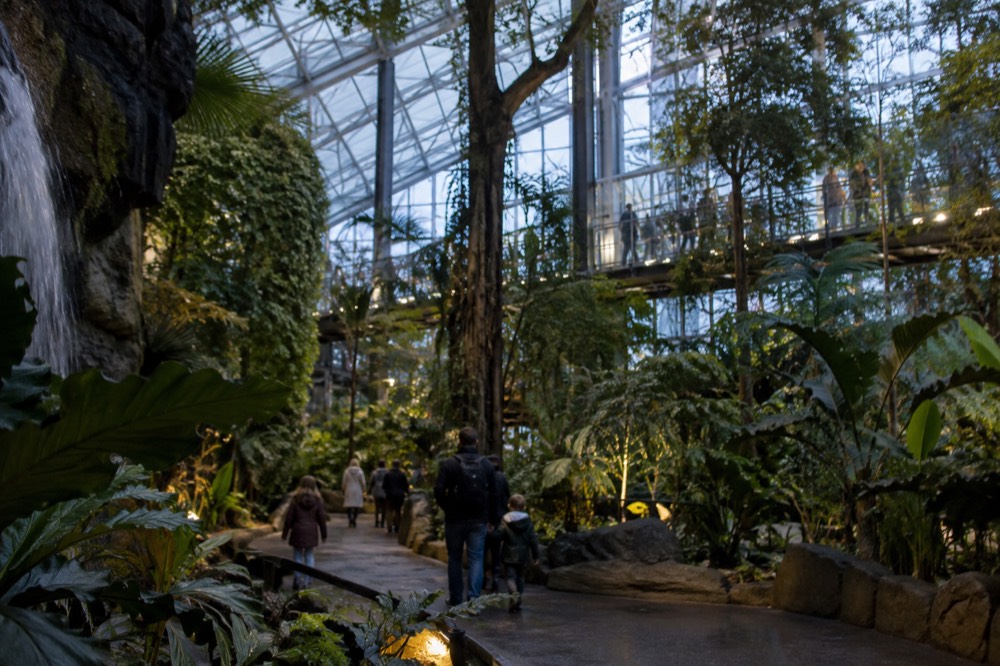
Universeum sits beside Universeumdalen at the edge of Gothenburg's event district, a glass-and-timber stack of exhibition halls built around a living rainforest that grows through the middle of the building. It is the city's science centre, and its own visit pages frame it as a full-day, all-weather destination. The question families actually ask is narrower: whose day is it? A four-year-old, a ten-year-old and a fifteen-year-old have very different visits inside the same walls, and the venue's ticketing rules quietly reflect that.
What Age Is Universeum Best For?
Universeum works best for children aged roughly three to twelve, with the sweet spot around six to ten, because the mix of aquarium, rainforest and hands-on halls is built for that range. Under 3s enter free but need their own ticket, and the separate Wisdome dome shows have an effective minimum age of four. Teenagers and adults still get a real visit, but they should target specific halls rather than expect the whole building to be pitched at them.
That is the short answer. The longer one depends on which part of the building you are standing in, because Universeum is not one experience. The venue's own site lists eleven distinct spaces: Akvariehallen, Regnskogen, Reptilariet, Rymdresan, Vildmarken, Humans, Mathrix, Vislab, Kemilabbet, Miniverseum and Wisdome. Miniverseum, as the name suggests, is the zone for the youngest visitors. Regnskogen, the multi-storey rainforest, works for almost everyone, which is why it is the part of the building that appears in most photographs.
One planning fact matters before any of this: admission is dynamically priced with a booked entry time, and there is no fixed published adult price. The venue's ticket page says so directly. On-site tickets cost the online price plus 30 kr, the whole venue is cashless, and free cancellation runs until 60 minutes before your slot. Busy days and popular slots sell out, which is a real risk in school holidays and on rainy days, of which Gothenburg has plenty. SMHI's 1991-2020 normals for the Göteborg A station record rain on about 127 days a year, so the indoor queue is not hypothetical.
The building's own history explains the age spread. Universeum opened in 2001 as a joint project between the city, Chalmers and a cluster of regional foundations, and its founding idea was that a science centre could carry a full rainforest biome and a Baltic aquarium under one roof. That dual identity, part museum and part living ecosystem, is why the venue can hold a toddler's attention in the aquarium and a teenager's attention in the canopy at the same time. Few science centres in Scandinavia attempt both.
Is Universeum Good for Toddlers and Preschoolers?
Yes, with limits. Under 3s enter free, but they need their own ticket, and the parts of the building that reward them are specific: Miniverseum, the aquarium hall and the lower levels of the rainforest. A toddler will not get a full day out of it, and the Wisdome dome shows, sold separately, carry an effective minimum age of four, so the headline attractions are off the table. Plan on two or three hours, not six.
The venue's design helps here. Akvariehallen is dim, quiet and slow, which suits small children well: sharks and rays drifting past glass are absorbing at any age, and a three-year-old will happily watch the same tank several times. Regnskogen has a walkway that lets a carried or stroller-aged child see the canopy layer, though a note of realism: the paths are steep in places and the humidity is real, so dress the child lightly.
The trade-off is attention span. The science halls, Mathrix and Kemilabbet especially, are pitched at school-age children and assume reading. A preschooler can still enjoy the water play and the physical exhibits in Miniverseum, but an adult should expect to steer, explain and take breaks. The venue is open 10:00 to 18:00 every day of the year, so an early arrival with a nap-time exit is entirely workable.
There is a practical note on food and rest. The venue has its own café spaces, and the surrounding event district at Korsvägen adds more options within a short walk, but for a toddler the useful detail is that the building is big enough to find a quiet corner when the crowd builds. Weekday mornings outside Swedish school holidays are the calm window; the venue's opening-hours page confirms the daily 10:00 to 18:00 schedule, and the quietest hour is reliably the first one.
For families combining the trip with the rest of Gothenburg, the transport fact is generous: a 24-hour Zone A Västtrafik ticket costs 125 kr and covers trams and buses across the city. Universeum sits at Korsvägen, one of the best-connected stops in the network, so the journey is a short tram ride from almost anywhere central.
Which Universeum Halls Suit Primary-School Children?
The six-to-ten range is the core audience and gets the most from the building. Regnskogen, the rainforest, plus Akvariehallen and Reptilariet deliver animals; Vildmarken, Rymdresan, Mathrix, Vislab and Kemilabbet deliver hands-on science at exactly the right level. This is the age group the venue is built around, and a full day, 10:00 to 18:00, is realistic.
Regnskogen deserves the hype. It is a genuine multi-storey rainforest under the glass roof, with free-roaming birds and monkeys, sloths and a raised walkway through the canopy. The venue includes all exhibitions, activities, shows and guided tours in admission, so the guided tours are not an upsell: they are part of the ticket, and for a reading-age child they turn the animals into a narrative rather than a list.
Vildmarken covers Scandinavian wildlife and the wider natural world, Rymdresan handles space, and Kemilabbet runs chemistry demonstrations. Mathrix and Vislab are the more screen-and-puzzle oriented spaces. A seven-year-old can move between all of these in a day, and the venue's layout, with the rainforest as the vertical spine, makes self-guided wandering easy.
The one thing to book deliberately is a Wisdome show. The dome's visual-heavy format is a genuine highlight for this age group, but it is a separate ticket on top of admission, with an effective minimum age of four. Check the day's programme when you book your entry slot, because the popular screenings fill first.

If you are planning a wider Gothenburg itinerary around this age group, the amphibious bus tour is the sightseeing equivalent of a science exhibit: the vehicle drives through the streets and then launches into the harbour, which tends to delight the same children who spend all day at Universeum. The tram network makes it easy to combine the two in one day.
Is Universeum Worth It for Teenagers and Adults?
Yes, but differently. Teens get the most from Regnskogen, Akvariehallen, Rymdresan and the Wisdome dome shows, and adults will find the rainforest and the aquarium genuinely good, but the hands-on halls are pitched below them. Do not sell a teenager a full day; a half-day visit with a Wisdome show booked is the right shape.
The rainforest is the part that survives adolescence. It is a real ecosystem, not a diorama, and the canopy walkway and the free-roaming animals hold attention without requiring any willingness to "do science". Akvariehallen works the same way: the tanks are large, the lighting is atmospheric, and a shark does not need an age rating.
Rymdresan, the space hall, and the Wisdome dome are the other strong cards for this age. The dome shows are immersive and visually serious, aimed at an audience that wants scale rather than cartoon framing. For adults, the same applies, and the fact that the venue is open every day of the year, 10:00 to 18:00, makes it a reliable rainy-day option when the archipelago ferries are unappealing.
One honest caveat: the building is loud and child-dense, especially on weekends and in school holidays. A teenager who is sensitive to that will prefer an early weekday morning slot, booked for 10:00, before the school groups arrive. The dynamic pricing means early slots are often the cheaper ones too, though the venue publishes no fixed price table, so check the booking page for your date.
There is also an annual-pass angle worth knowing for adults and older children on a longer stay. The venue sells an annual pass, discounted at the time of check, at 395 kr for a child and 545 kr for an adult, per its own ticket page. If a family is in Gothenburg for a week of mixed weather, a second or third visit changes the arithmetic completely, and the pass pays for itself faster than most city attractions because the base admission is time-slot priced rather than flat.
How Does Universeum Compare to Liseberg for Families?
For under-3s, Universeum wins on cost, since entry is free below that age while Liseberg charges from 95 kr for entry that includes no rides. For school-age children, Liseberg's rides usually win a straight preference contest, but its calendar is the catch: the park runs 18 April to 20 September in summer 2026, with Halloween 2 October to 1 November and Christmas 14 November to 23 December, and it is otherwise closed.
Liseberg's own ticket page makes the entry/ride split explicit: an Entré ticket from 95 kr gets you through the gate and onto nothing, rides need an Åkpass from 310 kr, and the combined ticket starts at 365 kr online. Children under 110 cm enter free. That is a different proposition from Universeum, where admission includes every exhibition, activity, show and guided tour, with only the Wisdome dome sold separately.
The calendars barely overlap in the shoulder seasons, which is the real planning point. A family visiting Gothenburg in March finds Liseberg shut, roughly from 24 December to mid-April, while Universeum is open 10:00 to 18:00 every single day of the year. A family visiting in July can do both, and many do: the two sit a short walk apart at Korsvägen.
| Universeum | Liseberg (2026) | |
|---|---|---|
| Open | Every day of the year, 10:00-18:00 | Summer 18 Apr-20 Sep; Halloween 2 Oct-1 Nov; Christmas 14 Nov-23 Dec; closed otherwise |
| Ticket model | Dynamic price, booked time slot; everything included except Wisdome shows | Entré from 95 kr (no rides); rides sold separately from 310 kr |
| Under-3s / under-110 cm | Free entry, own ticket required | Free entry under 110 cm |
| Best age | Roughly 3-12, sweet spot 6-10 | Roughly 6 and up for rides |
| Weather | Indoor, all-weather | Mostly outdoor |
| Booking | Time slots sell out; on-site costs online + 30 kr | Online cheaper than on-site; not sold on booking platforms |
What Do Families with Mixed Ages Need to Know?
Book one entry slot for everyone, including free under-3 tickets, and plan the day around the youngest child's rhythm while letting the oldest book a Wisdome show. The venue is cashless, so no card means no entry, and the dynamic pricing means the whole family's cost varies by date and slot, with no fixed published price to budget from in advance.
Mixed-age families are the normal case, and Universeum handles them better than most attractions because the vertical building lets you split and regroup. The rainforest spine connects the floors, so one adult can take the toddler to Miniverseum while the other climbs to the canopy walkway with the nine-year-old, and the aquarium hall is a natural meeting point.
Timing matters more than route. The venue opens at 10:00 sharp, and the first hour is the calmest, especially on weekdays outside Swedish school holidays. The lunchtime period is the busiest, and the afternoon thins out again. With free cancellation until 60 minutes before the slot, there is flexibility if the morning collapses, which with children it sometimes does.
A note on the weather question, because it drives more Universeum bookings than any marketing: Gothenburg's rain is real but seasonal in a specific way. SMHI's 1991-2020 normals for station Göteborg A put October as the wettest month at 102.9 mm and April as the driest at 51.3 mm, so an April visitor planning around the science centre may find the outdoor alternatives perfectly dry, while an October visitor will be grateful the building exists. The SMHI normals data is published station by station for anyone who wants the full table.
For the wider trip, Gothenburg is unusually easy on families with a spread of ages. The tram network, 12 lines and 188 km of track as of the operator's 2022 annual report, reaches everything, and the same 125 kr 24-hour Zone A ticket that covers the tram to Korsvägen also covers the ferries to the car-free southern archipelago, where the islands are part of the city, not a day trip. Our overview of what Gothenburg is known for covers the waterfront and archipelago side of a family visit, and if you are weighing the two big headline attractions, our comparison of Liseberg versus Tivoli looks at the other park question families ask. For the practical question of how long to allow the city at all, how many days in Gothenburg is enough breaks it down by itinerary length.
Common Questions About Universeum and Age
What age is Universeum best for?
Roughly three to twelve, with the sweet spot at six to ten. The venue's own halls, from Miniverseum for the youngest to the Wisdome dome for older children, are built around that range, and all exhibitions, activities, shows and guided tours are included in admission.
Is Universeum free for babies and toddlers?
Children under 3 enter free, but the venue's ticket page states they still need their own free ticket, so add them to the booking. The Wisdome dome shows are a separate ticket with an effective minimum age of four.
Can teenagers enjoy Universeum?
Yes. The rainforest, the aquarium hall, the space hall and the Wisdome dome shows all work for teens and adults. The hands-on science halls are pitched at primary-school level, so a half-day visit is the right shape for this age group.
How much do Universeum tickets cost?
There is no fixed published price. Admission is dynamically priced with a booked entry time, and the venue's own pages say on-site tickets cost the online price plus 30 kr. Check the booking page for your date, and book ahead because busy slots sell out.
Is Universeum open every day?
Yes. The venue states it is open every day of the year, 10:00 to 18:00, which makes it one of the few Gothenburg attractions with no seasonal closure, unlike Liseberg, which closes between seasons.
Do I need to book Universeum in advance?
Yes, for practical purposes. Entry is tied to a booked time slot, popular days and slots sell out, and cancellation is free until 60 minutes before your entry time. The venue is cashless, card only.
For more on the city itself, including whether Gothenburg is worth visiting for tourists, and the wider question of what Gothenburg is known for, the rest of Gothenburg Travel Guide covers the archipelago, the food scene and the transport system in depth.