A Rainy Day in Gothenburg, Sweden: What to Do When the Weather Turns
SMHI's 1991-2020 normals put Gothenburg's rain at 912 mm across 127 wet days a year, with October the wettest month at 102.9 mm. Here is how to spend a wet day well: museums with confirmed hours, food halls, covered quarters and dry-seat sightseeing.

Short answer
Gothenburg gets rain on about one day in three, heaviest in October at 102.9 mm. On a wet day, the city still works: Göteborgs konstmuseum charges 75 kr and is free under 20, Universeum is open every day of the year, Feskekôrka is a covered food hall, and the trams and archipelago ferries run on ordinary tickets.
Rain in Gothenburg is not a rumour. SMHI's 1991-2020 normals for station Göteborg A (71420) record 912 mm of precipitation a year spread across 127 days with at least 1 mm, which is close to one day in three. What the same data set also shows is that the rain is seasonal, front-loaded into autumn, and survivable. October is the wettest month at 102.9 mm; April is the driest at 51.3 mm. The city was laid out by Dutch engineers inside a moat, on a granite coast, for people who never expected the weather to cooperate. That inheritance is why a wet day here has real options: museums with confirmed hours, a fish church turned food hall, trams that arrive every few minutes, and covered sightseeing that never asks you to stand in the open. This page is the wet-day playbook, built on verified figures from SMHI, Västtrafik and the venues' own sites.
How Rainy Is Gothenburg, Really?
Gothenburg records 912 mm of precipitation a year across 127 days with at least 1 mm, per SMHI's 1991-2020 normals for station Göteborg A. The wettest month is October at 102.9 mm and the driest is April at 51.3 mm. The rain is concentrated in autumn and early winter, not spread evenly, and SMHI does not call Gothenburg Sweden's rainiest city.
That last point matters more than it sounds. The claim that Gothenburg is Sweden's rainiest city is the most repeated wrong statement about the place, and SMHI's own wording on the 1991-2020 normals says the national maxima sit in the western highlands and the mountains, where annual precipitation runs above 1000 mm. Gothenburg's 912 mm places it inside the wet western Götaland band, below the record areas. You can read the numbers on SMHI's normals page yourself.
The monthly shape of the rain is the practical part. Summer months sit in the 70-93 mm range, which in practice means showers, not washouts. October jumps to 102.9 mm across 12.6 wet days, and December carries 93 mm across 13.3 wet days, the highest wet-day count of the year. If you are choosing when to come, the seasonal guide at best time to visit Gothenburg covers the trade-offs in full.

| Month | Precipitation (mm) | Days with ≥1 mm |
|---|---|---|
| January | 83.0 | 11.5 |
| February | 61.0 | 9.7 |
| March | 54.0 | 8.8 |
| April | 51.3 | 8.2 |
| May | 54.3 | 8.8 |
| June | 73.7 | 10.0 |
| July | 81.3 | 9.8 |
| August | 92.8 | 11.9 |
| September | 80.0 | 10.8 |
| October | 102.9 | 12.6 |
| November | 84.7 | 12.0 |
| December | 93.0 | 13.3 |
Two readings from that table. April is the driest month of the year on both measures, so spring is the window if grey weather genuinely ruins a trip for you. And August, deep in the school-holiday peak, carries 92.8 mm: summer visitors do meet rain, just usually in bursts rather than day-long events.
Which Gothenburg Museums Work Best in the Rain?
The strongest wet-day museums are Göteborgs konstmuseum at 75 kr a day ticket with free entry for everyone under 20, Universeum which is open every day of the year from 10:00 to 18:00 with dynamic online pricing, and World of Volvo with exhibition tickets from 120 SEK online. All three are indoors, all three publish confirmed hours, and the konstmuseum includes the Hasselblad Center in its admission.
Start with the art museum, because it is the most central and the most generous. A single-visit ticket is 75 kr, students enter free with ID, and children and young people under 20 enter free for all exhibitions. Hours are Tuesday 11-18, Wednesday 11-20, Thursday 11-18, Friday to Sunday 11-17, closed Monday, plus several public holidays. The collection holds around 70,000 works and pulls roughly a quarter of a million visitors a year. One forward-looking fact from the museum's own rebuild page: it closes in 2028 and reopens in 2032 for an extension, and the site currently warns of intermittent blasting near the building, worth knowing if you are sensitive to sudden noise.
Universeum, the science centre, is the reliable all-ages fallback: open every single day of the year, 10:00-18:00, card only. Admission is dynamically priced against a booked time slot, so there is no fixed published adult price to quote; the venue states that buying on site costs the online price plus 30 kr, and that busy slots sell out. Everything inside, exhibitions, activities, shows and guided tours, is included, except Wisdome dome shows, which are a separate ticket.
World of Volvo is the newest of the three, opened in 2024 on Hisingen after the old Volvo Museum at Arendal closed permanently in December 2023. Exhibition tickets start from 120 SEK online with a 10% online discount, and hours run Monday to Wednesday 10-17, Thursday 10-19, Friday and Saturday 10-17, Sunday 10-16, all published on the venue's own tickets page. Do not plan a visit to the old museum site: the building at Gustaf Larsons Väg is closed, and every guide still listing it is out of date.

| Museum | Entry | Hours | Rainy-day note |
|---|---|---|---|
| Göteborgs konstmuseum | 75 kr; free under 20 and for students | Tue 11-18, Wed 11-20, Thu 11-18, Fri-Sun 11-17, Mon closed | Hasselblad Center included; closes 2028 for rebuild |
| Universeum | Dynamic pricing, book a time slot; on-site = online + 30 kr | Every day, 10:00-18:00 | Wisdome shows are a separate ticket |
| World of Volvo | From 120 SEK online | Mon-Wed 10-17, Thu 10-19, Fri-Sat 10-17, Sun 10-16 | Old Volvo Museum at Arendal closed Dec 2023 |
| Göteborgs stadsmuseum | Check the museum's own page for current admission | Check current hours before visiting | Set inside the Swedish East India Company building |
For a fuller run of wet-afternoon options, the museums overview page lists what is free, what needs tickets and what is closed on Mondays.
Can You Sightsee in Gothenburg Without Standing in the Rain?
Yes, and the amphibious bus is the headline option: a land-and-water sightseeing tour runs from 36 dollars per person, rated 4.7 from 4,326 reviews, and drives into the river mid-tour. The hop-on hop-off bus runs from 37 dollars per person, and the 50-minute canal cruise from 28 dollars per person covers the moat from under a roof. All three keep you drier than any walking plan.
The amphibious bus is the one that sells the concept: one vehicle, city streets first, then a launch ramp into the water for the harbour section, with commentary the whole way. The listing shows a 4.7 rating across 4,326 reviews, which makes it one of the most-reviewed sightseeing products in the city. The hop-on hop-off bus is the slower, cheaper alternative, from 37 dollars per person for a day ticket, rated 3.8 from 251 reviews, and its roof is the point on a wet afternoon. The canal cruise, rated 4.7 from 783 reviews, runs the old moat route that the Dutch engineers laid out, and you sit inside the entire time.
One planning note for Liseberg, since wet days push families toward it: the park's 2026 calendar runs 18 April to 20 September for summer, 2 October to 1 November for Halloween, and 14 to 23 December for the Christmas market, and it is fully closed in the gaps. An entry ticket from 95 kr buys no rides at all; rides need an Åkpass from 310 kr or a combined ticket from 365 kr. The full breakdown is in Liseberg rides, tickets and when to go, and rain there is a different problem: the park runs in the wet, it just closes between seasons.

Where Do You Eat on a Wet Day in Gothenburg?
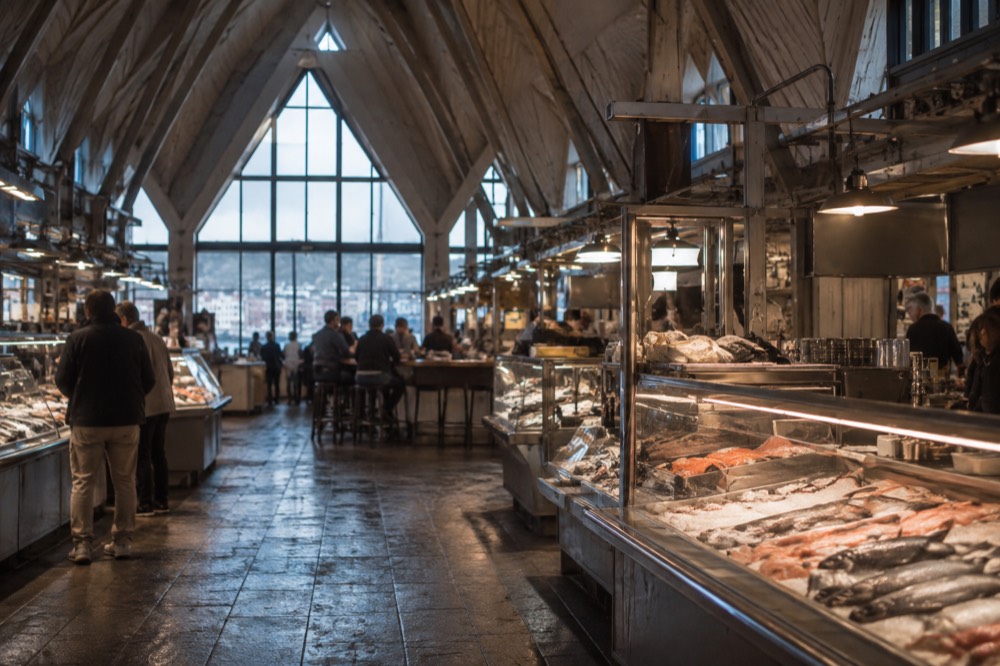
Feskekôrka, the fish church, reopened in 2024 as a full food hall with two fish counters and five restaurants, and it is entirely under one roof. Saluhallen is the other covered option. For a long rainy lunch, the shrimp and salmon cruise with live music runs 3 hours from 95 dollars per person, and the archipelago cruise with lunch runs 2.5 hours from 68 dollars per person, both of which turn bad weather into a warm cabin.
Feskekôrka is the building that looks like a church and was built in 1874 as a fish market. After a renovation it reopened in 2024, the year it turned 150, no longer as fish counters alone but as a food hall: Ebbes Fångst and Flåtens Fiskhandel sell fish, and the restaurant line-up is Haldis Kök, Pråmenaden, Victor von G, Lilla Åstol and Ekmans. Lilla Åstol is seasonal, its own site saying it reopens in spring. The whole point on a rainy day is architectural: one steep-roofed hall, everything inside, a short walk from Rosenlundskanalen. Our Feskekôrka guide covers what to order.
Saluhallen, the 19th-century market hall on Kungstorget, is the same idea in stone: counters, bakeries and hot food under one roof, in the middle of the shopping district. Between the two you can eat a full wet day without an umbrella. The wider food picture, including where the seafood reputation actually comes from, is in where to eat in Gothenburg.
Fika is the other wet-weather institution. A coffee and a cinnamon bun turns a grey hour into a planned stop, and Gothenburg's café density means you are rarely more than a block from cover. How fika works, what it costs and where the best rooms are is covered in fika in Gothenburg.
Do the Trams and Ferries Run in the Rain?
They run in everything. A single Zone A ticket costs 38 kr for an adult, a 24-hour Zone A ticket costs 125 kr, and both cover the trams, the buses and the southern archipelago ferries from Saltholmen. Västtrafik's own network is the point: the same ticket takes you from the centre out onto the open sea, and the islands are inside Zone A.
The tram network is the backbone of a wet day. Göteborgs Spårvägar's annual report describes 12 lines, 134 stops and 188 km of single track, running from Mölndal in the south to Angered in the north, and from Saltholmen in the west to Kålltorp in the east. The network carried 126 million journeys in 2025. Practically, that means the wait at a tram stop is short, and the stops themselves have shelters. The fare structure, zones, payment methods and the current temporary subsidy on 30-day tickets, which does not apply to the 24-hour and 72-hour tickets visitors buy, is all in getting around Gothenburg. The 125 kr day-ticket figure is published on Västtrafik's own Zone A ticket page.
The archipelago ferries are the surprise answer to rain. The southern islands, Asperö, Brännö, Styrsö, Donsö, Vrångö and Köpstadsö, are areas of the city of Gothenburg, not day trips, and the boats carry Västtrafik line numbers on the official zone map. A 125 kr day ticket covers the tram to Saltholmen and the ferry out. The ferries have indoor saloons, and a wet crossing with coffee is a legitimate rainy-day activity in itself. Private cars are banned on the islands, so the ferry is the only way regardless of weather. The full island-by-island picture is in the Gothenburg archipelago.
One weather caveat worth knowing: the sea peaks in temperature in August at 18.6 C, not July, and September water at 16.7 C is warmer than June water at 16.2 C, per SMHI's quality-controlled observations at Vinga. A rainy September ferry day is, swimming-wise, warmer than a sunny June one. The coldest water is February at 2.7 C.

What Is a Good Hour-by-Hour Rainy Day Plan?
A workable wet day runs: morning at Göteborgs konstmuseum or Universeum, lunch at Feskekôrka or Saluhallen, an afternoon canal cruise or amphibious bus tour, and an evening in the Linné quarter's café strip. Everything in that chain is indoors or covered except the short walks between them, and the whole day sits inside the tram network on one 125 kr day ticket.
The order matters less than the spine: the museums cluster around Götaplatsen and Avenyn, the food halls sit central, and the cruise departure points are on the canal a few blocks away. Here is the shape of it:
| Time | Plan | Cover |
|---|---|---|
| 10:00 | Universeum or Göteborgs konstmuseum | Fully indoors |
| 13:00 | Lunch at Feskekôrka or Saluhallen | Under one roof |
| 15:00 | Canal cruise or amphibious bus tour | Seated, covered |
| 17:00 | Fika and second-hand shops in Haga or Majorna | Shop-to-shop dashes |
| 19:00 | Dinner on the Linné and Långgatorna strip | Indoors, short walks |
Haga deserves its slot for a specific reason: the wooden old quarter is compact, the cafés are dense, and the famous oversized cinnamon buns are the point of the stop, so the rain becomes an excuse rather than an obstacle. The neighbourhood background is in Haga, Gothenburg's wooden old quarter. If the day is your only day in the city, the fuller dry-weather version is one day in Gothenburg, and the three-day plan covers what to push to tomorrow.
What About a Rainy Day with Kids?
Universeum is the anchor: open every day of the year, 10:00-18:00, with a rainforest hall, aquarium and reptile house all included in one admission, and children under 3 entering free. The Alfie Atkins cultural centre sells entry from 17 dollars per person, the Paradox Museum from 24 dollars, and Liseberg runs in the rain but only during its published seasons.
Universeum is close to purpose-built for this scenario: the rainforest zone is a multi-storey indoor canopy walk, the aquarium hall is underneath it, and the ticket covers all exhibitions, activities, shows and guided tours. Book a time slot online, because the venue states that busy days sell out, and on-site purchase costs the online price plus 30 kr. The age-by-age breakdown is in Gothenburg with kids.
The Alfie Atkins cultural centre, based on the Swedish picture-book character, sells admission from 17 dollars per person with a 4.4 rating from 29 reviews on the listing, and it is aimed at younger children. The Paradox Museum, from 24 dollars per person, rated 4 from 52 reviews, is the older-kid option: an illusion-and-photo museum that is entirely indoors and entirely about screens you can stand in front of.
Liseberg in the rain is a judgement call. The park does not close for wet weather, but it does close between seasons, and the 2026 gaps run from 21 September to 1 October, from 2 to 13 November, and from 24 December until mid-April, with the Kaninlandet kids' zone now opening winter weekends and school holidays. If it is open and raining, the queues are shorter and the rides still run; dress for it.
Is There Any Covered Shopping in Gothenburg?
Yes, and Nordstan is the big one: one of Scandinavia's largest shopping centres, fully indoors and directly connected to Göteborg Centralstation. Saluhallen adds a covered food stop, the arcades around Avenyn give partial cover, and the second-hand shops of Majorna and Vasastan make shop-to-shop dashes a workable rainy-day format.
Nordstan is the pragmatic answer: hundreds of shops under one roof, attached to the central station, so a tram or the airport coach drops you inside. On a genuinely wet afternoon it is where the city visibly relocates.
The second-hand quarter works differently. Majorna's charity shops and vintage stores sit close together on Linnégatan's side streets, and Vasastan's student cafés fill the gaps between them. The rhythm is five minutes of rain, twenty minutes of browsing, repeat. It is not covered, but it is compartmentalised, which on a showery day is nearly as good.
What If the Rain Stops for an Hour?
Head for the viewpoints, because they cost nothing and the post-rain light on the Kattegat is the city's best free show. Skansen Kronan, Masthuggskyrkan and Ramberget are all reached by tram plus a short climb, and the grey-then-clear sky over the archipelago is the exact condition photographers wait for.
Skansen Kronan is the hilltop fort above Haga, Masthuggskyrkan's churchyard terrace looks straight down the harbour, and Ramberget on Hisingen gives the full skyline with shipyard cranes in the foreground. All three are free, all three are ten-to-twenty-minute walks from tram stops, and all three are better in broken weather than in flat blue sky.
Slottsskogen is the other free reset: a huge park with a free zoo section, which in drizzle means moose and seals in the wet, and penguins at feeding time. The park costs nothing to enter, which makes it the cheapest possible way to use a dry hour.

Does a City Pass Help on a Rainy Day?
It can, with one caveat. The old Göteborg City Card no longer exists; the current product is the Go City pass, sold as an Essentials Pass covering 3 attractions over 30 days and an All-Inclusive Pass covering 20-plus attractions over 1 to 5 days. Unlike the old municipal card, there is no confirmed public-transport inclusion, so budget the 125 kr day ticket separately.
A rainy day is exactly the scenario a pass is built for: you chain indoor attractions, and the per-attraction cost is what the pass compresses. The Go City Essentials Pass is listed from 47 dollars per person, rated 4.3 from 5 reviews, and the All-Inclusive version from 56 dollars per person, rated 3.8 from 238 reviews. Whether the maths works depends on how many of the covered venues you will actually visit in a day, and the honest breakdown, including what replaced the old card and what it no longer includes, is in the Gothenburg city card, is it worth it.
For a longer stay where one wet day has to be absorbed rather than survived, the three days in Gothenburg plan builds in indoor slack between the outdoor highlights.
Common Questions About Rainy Days in Gothenburg
Is Gothenburg Sweden's rainiest city?
No, and SMHI's own data does not support the claim. The 1991-2020 normals put Gothenburg at 912 mm a year, inside the wet western Götaland band, while the national maxima sit in the western highlands and the mountains at over 1000 mm. The label is the city's most repeated cliche and it is wrong.
What is the wettest month in Gothenburg?
October, at 102.9 mm across 12.6 days with at least 1 mm, per SMHI's 1991-2020 normals for station Göteborg A. April is the driest month at 51.3 mm on 8.2 wet days.
Do the archipelago ferries run when it rains?
Yes. The ferries from Saltholmen are part of the ordinary Västtrafik network, the islands are in Zone A, and a 125 kr 24-hour ticket covers tram and ferry together. The boats have indoor saloons, and the islands are areas of Gothenburg rather than day trips.
Is Liseberg open in the rain?
Liseberg runs in wet weather but closes between seasons. In 2026 the summer season runs 18 April to 20 September, Halloween 2 October to 1 November, and the Christmas market 14 to 23 December. A 95 kr entry ticket includes no rides; a combined entry and ride ticket starts at 365 kr.
Is Universeum a good rainy-day option?
Yes. It is open every day of the year from 10:00 to 18:00, everything except Wisdome dome shows is included in admission, and the venue is fully indoors. Admission is dynamically priced against a booked time slot, with on-site purchase costing the online price plus 30 kr.
What is free to do in Gothenburg when it rains?
The viewpoints at Skansen Kronan, Masthuggskyrkan and Ramberget cost nothing, Göteborgs konstmuseum is free for everyone under 20 and for students, Slottsskogen's zoo section is free, and the covered Feskekôrka and Saluhallen halls cost nothing to walk through.
The rain in Gothenburg is real, measurable and mostly an autumn problem. The city's answer to it is structural: trams every few minutes, museums with long hours, food halls under historic roofs, and ferries with saloons that cross open sea on an ordinary ticket. Pack a decent jacket, book the Universeum slot in advance, and let the 127 wet days a year do their worst. More seasonal planning, including the winter version of this problem, is in Gothenburg in winter and across the itineraries on Gothenburg Travel Guide.