Is Gothenburg a Rainy City? What SMHI's Data Actually Shows
Is Gothenburg a rainy city? SMHI's 1991-2020 normals show 912 mm a year across 127 wet days, with October the wettest month and April the driest. Here is what the data means for a visitor to Gothenburg, Sweden.
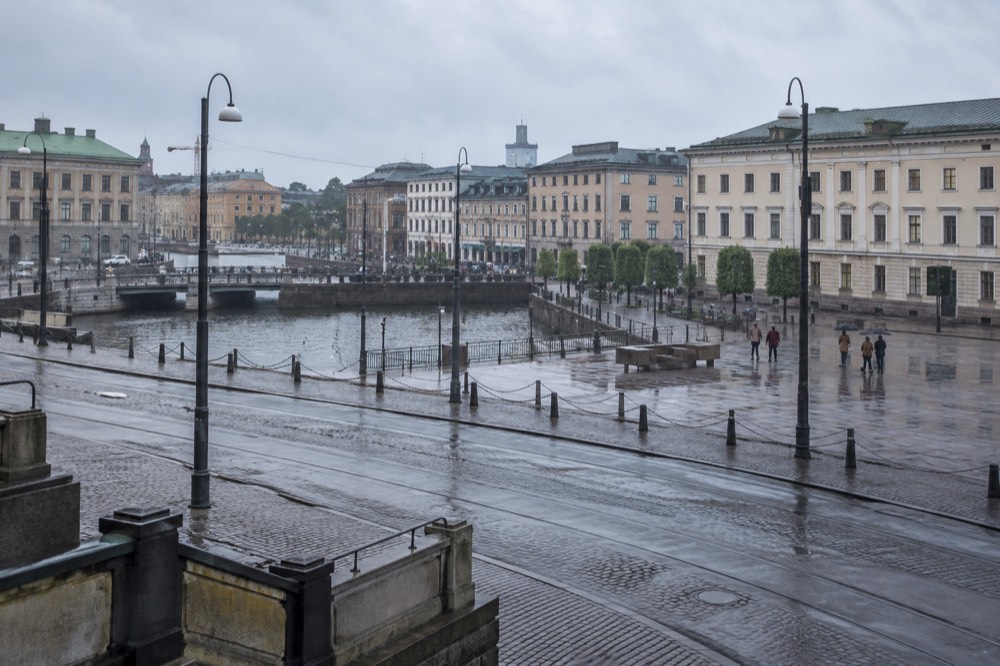
Gothenburg, Sweden carries a reputation for rain the way it carries the smell of salt off the Kattegat: constantly, and without much discussion. The reputation is not invented. The Swedish Meteorological and Hydrological Institute's 1991-2020 normals for station Göteborg A (71420) record 912.0 mm of precipitation a year, spread across 127.3 days with at least 1 mm of rain. That is roughly one day in three. It is a wet city. But the details behind that headline contradict almost everything the cliché implies: the rain is an autumn phenomenon, not a summer one, April is the driest month of the year, and SMHI's own published wording does not call Gothenburg Sweden's rainiest city at all. The national precipitation maxima, in SMHI's normals description, sit in the western highlands and the mountain fjäll country, where annual totals run past 1000 mm.
This page takes the question apart with the actual station data: how much rain, when it falls, how it compares with the rest of Sweden, and what a visitor should realistically plan around. The numbers come from SMHI's normals spreadsheets for the 1991-2020 period, which is the official thirty-year reference window Swedish meteorology uses for every "normal" figure in the country.
Is Gothenburg a Rainy City?
Yes, Gothenburg is a rainy city by any honest measure: SMHI's 1991-2020 normals for station Göteborg A record 912 mm of precipitation a year falling on 127 days, about one day in three. But the rain is heavily weighted towards autumn, October is the wettest month at 102.9 mm, and April is the driest at 51.3 mm, so the wet reputation and the tourist summer are two different seasons. SMHI's own data does not support the claim that Gothenburg is Sweden's rainiest city.
That last sentence matters more than it sounds. The phrase "Sweden's rainiest city" is the single most repeated weather claim about Gothenburg, and it appears in travel copy, forum threads, and casual conversation across the internet. When you go to the primary source, it is not there. SMHI's description of the 1991-2020 normal period states that annual precipitation varies "från ca 400 till 600 mm" in the eastern parts of Götaland and Svealand and the Norrland coast and inland, "till över 1000 mm i fjälltrakterna och i de västra delarna av Götaland", meaning over 1000 mm in the mountain regions and the western parts of Götaland. Gothenburg's 912 mm sits inside that wet western band, comfortably. The western highlands and the mountains are wetter. The city is wet. It is not the wettest.
So the honest framing is: rainy, yes, and reputationally exaggerated, also yes. One day in three with measurable rain is a city where a rain jacket lives in your day bag. It is not a city where it rains all the time, and it is emphatically not a city where the rain is evenly spread across the year. The distribution is the part that matters for planning, and the next section shows it month by month.
When Does the Rain Actually Fall in Gothenburg?
The rain in Gothenburg concentrates in autumn and winter: October is the wettest month at 102.9 mm, followed by December at 93.0 mm and August at 92.8 mm, while April is the driest month of the entire year at 51.3 mm across only 8.2 wet days. Late spring, not summer, is the dry window. The tourist high season of June and July sits in the middle of the table, at 73.7 mm and 81.3 mm respectively.
Here is the full monthly picture from SMHI's normals for station Göteborg A, the reference station for the city. The underlying dataset is published by SMHI on its normals page for the 1991-2020 period, Dataserier med normalvärden för perioden 1991-2020, which holds the per-station spreadsheets these figures come from:
| Month | Precipitation (mm) | Days with ≥1 mm | Mean air temp (C) |
|---|---|---|---|
| January | 83.0 | 11.5 | 0.8 |
| February | 61.0 | 9.7 | 0.7 |
| March | 54.0 | 8.8 | 3.0 |
| April | 51.3 | 8.2 | 7.7 |
| May | 54.3 | 8.8 | 12.4 |
| June | 73.7 | 10.0 | 15.7 |
| July | 81.3 | 9.8 | 18.3 |
| August | 92.8 | 11.9 | 17.7 |
| September | 80.0 | 10.8 | 14.0 |
| October | 102.9 | 12.6 | 9.0 |
| November | 84.7 | 12.0 | 5.1 |
| December | 93.0 | 13.3 | 2.1 |
| Year | 912.0 | 127.3 | 8.9 |
Read the table as a planning document rather than a weather report. The two facts that jump out are these. First, the wettest month of the year is October, with 102.9 mm, and December has the most wet days, 13.3 on average. The rain arrives after the tourists leave. Second, April is the driest month of the year, drier than every summer month, on the fewest wet days of any month. If dryness is your priority, late April and May beat July, and the shoulder season also comes with thinner crowds at places like Liseberg and the archipelago ferries. The trade-off, of course, is temperature: April averages 7.7 C against July's 18.3 C, and the sea is a bracing 7.1 C in April against 18.3 C in July, per SMHI's oceanographic archive at the Vinga station.
There is a secondary pattern worth knowing. The summer rain, when it comes, tends to come in heavier, shorter bursts: June and July have fewer wet days than October or December but comparable or higher totals per wet day. Autumn and winter rain is the long grey drizzle the reputation is built on, the kind that sits over the harbour for a week. Summer rain is the kind that interrupts a day rather than defining it. Neither is a reason to cancel anything, but they call for different packing, a point covered in our general advice on the best time to visit Gothenburg.
If you are weighing Gothenburg against other Nordic city breaks on the rain question alone, the comparison is closer than the stereotypes suggest. Stockholm's eastern position gives it a drier climate type in SMHI's national description, but Gothenburg's rain is not tropical-monsoon territory either; it is a North Sea pattern, familiar to anyone who has spent an October in Scotland or the Netherlands. For a fuller sense of what the city offers against that backdrop, see our piece on whether Gothenburg in Sweden is worth visiting.
Is Gothenburg's Rain Reputation Deserved?
Partly. The reputation is deserved in the sense that 912 mm a year and 127 wet days genuinely make Gothenburg one of Sweden's wetter major cities, sitting in SMHI's wet western Götaland band. It is undeserved in the sense that the popular claim, that Gothenburg is Sweden's rainiest city, does not appear in SMHI's data or wording, and the rain is concentrated in autumn and winter rather than spread across the visiting season.
The reputation has a real physical basis. Gothenburg sits at 57.7 N on the west coast, at the mouth of the Göta älv, directly exposed to Atlantic weather systems that track east across the Kattegat. The western side of southern Sweden is wetter than the east in SMHI's national normals, full stop. When a low-pressure system comes in off the North Sea, Gothenburg is the first big city it meets. That geography is why 912 mm lands here while eastern Götaland and Svealand average 400 to 600 mm in SMHI's description. The wider set of guides lives on Gothenburg Travel Guide.
But notice what the reputation does with that fact. It converts "one of the wetter cities in a generally not-very-wet country" into "the rainiest city", and it converts "autumn and winter are wet" into "it always rains". Both conversions are wrong, and both are the kind of lazy repetition that a site like this one, which reports from primary sources, exists to correct. SMHI's own knowledge-base page on the 1991-2020 normal period is the authority here, and its wording credits the over-1000-mm totals to the fjäll regions and western Götaland generally, not to any city.

There is also a cultural layer. Gothenburgers themselves keep the joke running. The city's self-deprecating humour about its weather is a point of local pride, and a visitor who arrives in a dry, sunny June week may honestly wonder what everyone is complaining about. The complaints are mostly about November, when the daylight has shrunk towards the 6 h 32 m solstice minimum, the rain is at 84.7 mm for the month, and the combination does the psychological work that neither does alone. Our article on what Gothenburg is known for covers how deeply this maritime-grey identity runs through the city's culture.
The honest verdict for a traveller: pack for rain, expect to use the rain jacket a third of your days, and do not let the reputation shape your itinerary, because the rain that built the reputation mostly falls outside the months you would visit anyway.
What Does 127 Wet Days a Year Feel Like on an Actual Trip?
A visitor should picture rain as a frequent guest rather than a permanent host: 127 wet days a year means roughly one day in three sees at least 1 mm of rain, but those days cluster in October through February, and the rain in summer months often arrives as short showers rather than all-day drizzle. In practical terms, a week in June or July typically includes two or three wet days, most of them partly usable.
The arithmetic is straightforward. 127.3 days with at least 1 mm, out of 365, works out to about one day in three. But the monthly wet-day counts range from 8.2 in April to 13.3 in December, so a week in April averages under two wet days while a week in December averages over three, and December rain is likelier to last all day. Add the daylight variable and the seasons feel far more unequal than the rainfall table alone suggests. On 21 June the sun is up 18 h 06 m, with only about three and a half hours of true night; on 21 December it is up 6 h 32 m. A rainy June afternoon is an interruption in a long bright day. A rainy December afternoon is most of the day.
What this means for planning, concretely:
- April and May: the driest stretch of the year, 51.3 and 54.3 mm, cool air, sea still cold at 7-11 C. Best for walkers who do not mind a jacket.
- June and July: moderate rain, 73.7 and 81.3 mm, the warmest air at 15.7 and 18.3 C, the longest days. The classic visiting window, and the rain is not the argument against it.
- August: wetter, 92.8 mm, but the sea peaks at 18.6 C, warmer than July's water. Swimmers should note the sea runs weeks behind the air.
- September: 80.0 mm and 10.8 wet days, with sea still at 16.7 C, warmer than June. An underrated month.
- October through December: the wet season proper, 102.9, 84.7 and 93.0 mm. Museum weather, fika weather, Christmas-market weather from mid-November.
The city is built for this, which is the part the reputation misses. The indoor infrastructure is excellent: Universeum is open every day of the year, the museum quarter around Götaplatsen packs several institutions within a few hundred metres, and the café culture, fika, exists partly as a civilised response to grey weather. Trams run on 188 km of track through all of it, so wet days do not strand you the way they can in a city built around walking or cycling alone. If the rain does catch you out, our guide to where to avoid in Gothenburg and, more usefully, the city's covered and indoor options make a washout day recoverable.
How Should You Pack and Plan Around Gothenburg's Rain?
Pack a real waterproof layer and waterproof shoes for any season, because even the driest month averages eight wet days, but do not plan around rain in the way you would for a genuinely tropical destination: the rain is rarely heavy, snow is more common than downpours in winter, and the practical response is a wardrobe of layers plus a willingness to shift one indoor item into each day's plan rather than a rain contingency for every day.
The layering advice is standard for Sweden at 57.7 N and non-negotiable here. Mean air temperature is 8.9 C for the year, swinging from 18.3 C in July to 0.7 C in February, and the maritime air makes damp cold feel sharper than the thermometer suggests. A shell jacket over a fleece handles most of the year. Umbrellas are common but the harbour wind makes a hood more reliable than a frame.
Planning advice is where the data earns its keep. Because the rain clusters in autumn, a summer visitor's real weather risk is not rain but the reverse: June's 18 hours of daylight lull people into overlong days. Book the outdoor priorities, the archipelago ferries, kayaking, the amusement park, for the start of your trip so a wet day later can absorb the indoor items instead. Liseberg's summer season runs mid-April to late September, and its calendar is the single most date-sensitive item in the city, so check the season dates before you build a day around it. For the islands, an ordinary Västtrafik Zone A ticket covers the tram to Saltholmen and the ferry out, so a weather-delayed island day costs you nothing but time; our piece on whether the Gothenburg archipelago is worth visiting goes into the practicalities.
And keep the numbers in proportion. 912 mm a year is less than Bergen, less than most of western Scotland, and roughly comparable to Amsterdam. Nobody cancels a trip to Amsterdam over the rain statistics. Gothenburg's version of the same climate comes with better summer daylight, a tram network that runs through it, and a culture that has spent four hundred years building cosy interiors against it. The rain is real, the reputation is exaggerated, and the data says visit anyway.
For the days when the drizzle settles in, sightseeing options that work in the wet are worth booking in advance. The amphibious bus is the clearest example: it drives Gothenburg's streets as a covered vehicle and then rolls into the harbour as a boat, so the same ticket is a city tour in rain and a harbour cruise in clear weather. The canal cruise runs a similar calculation, covering the moat route from inside the boat, and a [multi-attraction pass](https://gocity.tpk.ro/HQKyKKW4) lets you reshuffle indoor museums into a wet afternoon without paying per door. Check availability on the listings above and let the forecast, not the reputation, set the order of your days.
Common Questions About Rain in Gothenburg
Is Gothenburg a rainy city?
Yes. SMHI's 1991-2020 normals for station Göteborg A record 912 mm of precipitation a year across 127 days, about one day in three. The rain is concentrated in autumn and winter, with October the wettest month, and April is the driest month of the year.
Is Gothenburg the rainiest city in Sweden?
There is no primary-source support for that claim. SMHI's description of the 1991-2020 normals places the national precipitation maxima in the western highlands and the mountain fjäll regions, with annual totals over 1000 mm, while eastern Götaland and Svealand average 400 to 600 mm. Gothenburg's 912 mm sits in the wet western band but is not identified as the country's maximum.
What is the wettest month in Gothenburg?
October, with 102.9 mm of precipitation across 12.6 wet days on average, according to SMHI's 1991-2020 normals for station Göteborg A. December has the most wet days, 13.3 on average.
What is the driest month in Gothenburg?
April, with 51.3 mm across just 8.2 wet days, making it drier than every summer month. May is nearly as dry at 54.3 mm.
Does it rain more in Gothenburg in summer or autumn?
Autumn, clearly. October (102.9 mm), December (93.0 mm) and August (92.8 mm) lead the year, while June and July sit mid-table at 73.7 and 81.3 mm. The rain that built Gothenburg's wet reputation falls mostly outside the main visiting season.
Should rain affect when I visit Gothenburg?
Only mildly. Summer visitors get the warmest air, the longest days, up to 18 h 06 m of daylight in late June, and moderate rainfall. April and May are the driest months but cooler. Pack a waterproof layer for any season and keep one indoor option in reserve for each day rather than planning around the rain.