What Are Some Areas to Avoid in Gothenburg, Sweden?
An honest answer to which parts of Gothenburg, Sweden are worth skipping, which are just mistimed, and which warnings you can safely ignore.
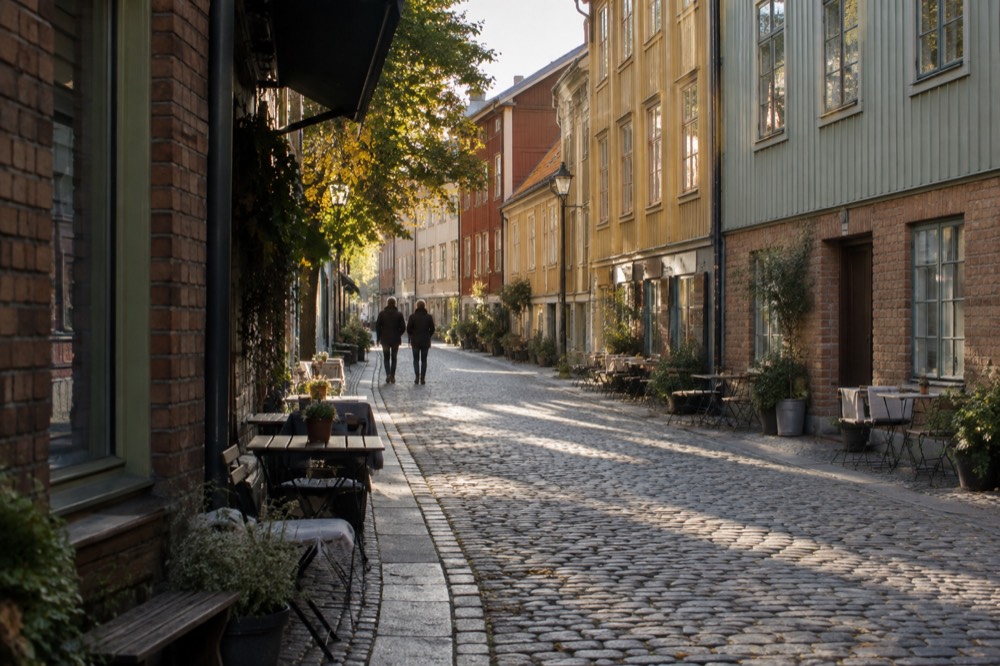
Gothenburg recorded over 6 million commercial guest nights in 2025, a record year with the strongest growth in Sweden, according to Göteborg & Co's January 2026 press release. Millions of people walk its streets, ride its 12 tram lines and swim off its car-free islands, and the city's safety reputation is genuinely strong. So when someone asks which areas to avoid in Gothenburg, the honest answer has two parts: there is no district a normal visitor needs to fear, and there are several places where careless planning wastes a day. This page separates the real pitfalls from the imaginary ones, using the city's own published information rather than forum folklore. Göteborgs Stad, Västtrafik, Liseberg and SMHI publish everything needed to avoid every trap on this list.
Are There Dangerous Areas to Avoid in Gothenburg?
No neighbourhood in Gothenburg is a no-go zone for visitors, and the city's own tourism and municipal reporting describes it as a safe, walkable destination. The practical "areas to avoid" are not districts at all: they are closed attractions, mistimed visits and a handful of crowded transport moments, each of which is easy to plan around with public information.
Sweden's second city, population 613,274 at the end of 2025 according to Göteborgs Stad, is the kind of place where the standard advice is common sense rather than avoidance. Central districts such as Inom Vallgraven, Haga, Vasastan, Majorna and Linné all function as ordinary mixed neighbourhoods where people live, work and go out. The violent-crime stories that occasionally make international news about Sweden concern events and locations that have no bearing on a visitor's itinerary in Gothenburg.
That does not mean the question is silly. It means the answer changes shape. Instead of "avoid this postcode", the useful warnings are:
- arriving in winter to find Liseberg, the city's biggest attraction, completely closed
- travelling to Arendal to visit a Volvo Museum that shut permanently in December 2023
- buying a 95 kr Liseberg entry ticket and discovering it includes zero rides
- paying full price for a tram ticket when the right ticket for your plans costs less
- standing on a windy January pier wondering why nobody else is swimming
The rest of this page works through each of these in turn, because each one ruins a day far more reliably than any street does. For a broader picture of what the city actually offers, start with what Gothenburg is known for.
Which Gothenburg Spots Are Best Skipped or Carefully Timed?
Three places belong on a "do not just turn up" list: the closed Volvo Museum site at Arendal, the old Volvo Museum address on Gustaf Larsons Väg, which shut its doors permanently in December 2023, Liseberg during its long closed season from 24 December until mid-April, and Göteborgs konstmuseum once its planned 2028 closure for rebuilding begins, with intermittent blasting already occurring near the building now.
The Volvo Museum is the biggest stale fact in circulation about Gothenburg. Its successor, World of Volvo, states it plainly on its own site: "After Volvo Museum in Arendal, Gothenburg, Sweden, closed its doors in December 2023, we are now taking over." Any guide, app or list that still sends you to Gustaf Larsons Väg is sending you to a shut building in an industrial peninsula far from the centre. The replacement, World of Volvo at Lyckholms Torg, is a different kind of attraction, an experience centre rather than a classic museum, and its own visit pages list hours of Mon-Wed 10:00-17:00, Thu 10:00-19:00, Fri-Sat 10:00-17:00 and Sun 10:00-16:00, with exhibition tickets from 120 SEK online.
Liseberg's calendar is the trap that ruins more trips than any other. The park's own pages confirm the 2026 seasons: summer from 18 April to 20 September, Halloween from 2 October to 1 November, and the Christmas market from 14 November to 23 December. Between those windows the park is closed, roughly 21 September to 1 October, 2 to 13 November, and from 24 December until mid-April. A visitor arriving in late January or early March finds the biggest attraction in the city shut, and no amount of good weather changes that. The one partial exception is new for 2026: Kaninlandet, the family land, now also opens on winter weekends and school holidays.
Göteborgs konstmuseum is a third place to time carefully. The museum's own rebuild page states: "Enligt nuvarande tidplan stänger konstmuseet 2028 och återöppnar 2032." Before that closure, the museum already warns of intermittent blasting near the building and flags it for sensitive visitors. Until 2028 the museum is fully open and excellent, with a 75 kr day ticket, free entry for everyone under 20, and the Hasselblad Center included in admission, but plan around the closure if your trip falls after it.
Where Do the Practical Gothenburg Traps Actually Bite?
The traps that cost visitors money cluster around tickets rather than districts: a 95 kr Liseberg entry ticket buys zero rides, the temporary half-price Västtrafik subsidy applies only to 30-day period tickets and not to the 24-hour or 72-hour tickets visitors buy, and the old Göteborg City Card no longer exists, replaced by a Go City product that works on entirely different terms.
Start with Liseberg's pricing structure, because it catches almost everyone. The park's own ticket page lists Entré from 95 kr, children under 110 cm free, but Liseberg's own wording on the ride pass is explicit: "Fria åk i Lisebergsparkens attraktioner. Entrébiljett ingår ej." The 95 kr ticket gets you through the gate and onto nothing. The combined Entré + Åkpass starts at 365 kr online, and an Åkpass alone, which does not include entry, starts at 310 kr. On-site prices are higher than online, the park says so itself. Anyone who budgets "95 kr for Liseberg" has budgeted for a walk around a park full of rides they cannot ride.
On transport, a temporary state subsidy has halved the price of every ordinary 30-day period ticket in the Västtrafik region, Zone A adult dropping from 890 kr to 445 kr. Västtrafik's own announcement is clear that this is "ett tillfälligt statligt stöd som gäller för resor året ut", a temporary state support valid for travel through the end of the year. What it does not cover is the day tickets a visitor actually buys. The 24-hour Zone A ticket remains 125 kr, and a single adult fare in one zone remains 38 kr. Writing "transport is half price in Gothenburg" would be wrong; writing "monthly tickets are half price, day tickets are not" is correct.
The city pass landscape changed too. The official destination organisation, goteborg.com, sells no city card at all, and the old gothenburgpass.com address now redirects to Go City. The old municipal Göteborg City Card and its transport inclusion are gone, and the replacement Go City product should be evaluated on its own published terms rather than the old card's reputation. For the full comparison, read the guide to whether the Gothenburg city card is worth it.
Here is the trap list in table form:
| Trap | What goes wrong | The fix, from the source |
|---|---|---|
| Liseberg Entré only, 95 kr | Entry with zero rides included | Buy Entré + Åkpass from 365 kr online, per liseberg.se |
| Old Volvo Museum, Arendal | Closed permanently December 2023 | Visit World of Volvo, Lyckholms Torg, per worldofvolvo.com |
| Assuming a half-price tram fare | Subsidy covers 30-day tickets only | 24-hour Zone A ticket is 125 kr, per vasttrafik.se |
| Old "Göteborg City Card" advice | That card no longer exists | Check Go City's own current terms, per gocity.com |
| Konstmuseum after 2028 | Museum closed for rebuild until 2032 | Visit before the closure, per goteborgskonstmuseum.se |
If the pricing rules feel like homework, a guided tour sidesteps them: one booking covers the route, the guide and the timing, and the operator's live listing states the current cancellation terms before you pay.
Which Gothenburg Neighbourhoods Get Unfairly Warned About?
Majorna, Linné, Vasastan and the archipelago islands are the places most often mentioned in cautious forum threads, and all of them are ordinary, well-visited parts of the city that no visitor needs to avoid, with the islands in particular sitting inside Gothenburg's own Västtrafik Zone A and reached by ordinary tram and ferry tickets.
Majorna, the second-hand and working-class district west of the centre, sometimes gets described in outdated threads as rough. It is in fact one of the city's most characterful neighbourhoods, and it is interesting enough that a free GuruWalk tour, "Majorna, were Gothenburg comes alive", runs there with a 4.77 rating from 234 reviews, covering the history, the people and the culture over an hour and a half. A district with a well-reviewed free walking tour is not a district to avoid. The same logic applies to the Linné and Vasastan areas, which are student-and-café quarters where the main hazard is an expensive cinnamon bun.
The southern archipelago islands, Styrsö, Brännö, Vrångö, Donsö, Asperö and Köpstadsö, occasionally get flagged as "too remote" or treated as a separate day trip. They are neither. Västtrafik's own zone material confirms the islands are in Zone A, and the ferries from Saltholmen carry ordinary Västtrafik tickets, so a 125 kr 24-hour Zone A ticket covers the tram to Saltholmen, the ferry out and every island in between. Saltholmen is itself the western terminus of the tram network, so the journey is a single continuous ride. Göteborgs Stad's own study confirms the islands are protected from private car traffic, with only taxi, färdtjänst and emergency services on the roads, which makes them quieter and safer than the mainland, not riskier.
The one genuinely remote-feeling mistake is Saltholmen parking. Drivers who head there by car find limited spaces at a ferry terminal that exists precisely because the tram goes there. Arrive by tram and the problem disappears. For the full island picture, see whether it is worth visiting the Gothenburg archipelago.
What Should You Avoid Doing in Gothenburg Rather Than Avoid Seeing?
Avoid four behaviours rather than four districts: do not visit in the dead of winter expecting Liseberg, do not buy beer above 3.5% ABV anywhere but Systembolaget, do not expect a train to Landvetter Airport because no rail link exists, and do not swim in June expecting warm water, since SMHI's Vinga station data shows the sea peaks in August at 18.6 C while June sits at just 16.2 C.
The alcohol rule is statutory and exact. Alkohollag (2010:1622), 1 kap. 8 § defines the boundary: beer above 2.25% but not above 3.5% ABV is folköl, sold in supermarkets, while anything above 3.5%, plus all wine and spirits, is retail monopoly territory. The practical consequence is that supermarket beer in Sweden is often a 3.5% reformulation of a stronger brand, and anything proper needs a Systembolaget run, with Sunday closing the operative planning fact. Anyone planning a Saturday-evening dinner party should shop before the weekend.
The airport point surprises people. Swedavia's own transport pages for Landvetter list only coach and bus options, because there is no rail link. The airport coach is now branded Vy flygbussarna, not Flygbussarna, and Swedavia states the journey time to central Gothenburg as 20 minutes, running to Korsvägen and Göteborg C's Nils Ericson Terminalen. Västtrafik bus 612 also serves the airport, and FlixBus line 691 runs a parallel city route. The mistake to avoid is not the area but the assumption: do not budget for a train that does not exist.
The swimming point is the most counterintuitive. SMHI's quality-controlled hourly observations from the Vinga lighthouse station show the sea temperature peaking in August at 18.6 C, not July, and September water at 16.7 C is warmer than June water at 16.2 C. February, at 2.7 C with a record low of -1.2 C, is the coldest month, because brackish Kattegat water does not freeze at 0 C. A September archipelago swim is warmer than a June one, which is the opposite of what most visitors book. For more on this, see the guide to swimming and beaches in Gothenburg.
Is Any Part of Gothenburg Worth a Simple Time-Of-Day Warning?
Yes, and the warnings are all about crowds and light rather than crime: Nordstan and the Avenyn end of Kungsportsavenyn are at their most congested on Saturday evenings, the ferry piers at Saltholmen queue hardest on fine summer weekends, and the entire city centre feels emptier on Sundays and public holidays when many Swedish shops close.
None of these are safety issues. They are comfort issues. Nordstan, the shopping complex by Göteborg Centralstation, is one of Scandinavia's largest city-centre malls and simply gets busy, which matters if you are dragging luggage through it on a Saturday. Avenyn, the parade street running up to Götaplatsen, is the nightlife spine, and its weekend evenings are loud and crowded in the ordinary way of any European nightlife district. If loud and crowded is not your evening, the Linné strip and Majorna offer calmer alternatives a short tram ride west.
Daylight is the other time-of-day factor, and in winter it is not optional knowledge. The US Naval Observatory's figures for Gothenburg's latitude show 21 December giving 6 hours 32 minutes of daylight, sunrise at 08:54 and sunset at 15:26, against 18 hours 06 minutes on 21 June. December's civil twilight extends the grey light barely eight hours. A December visitor who starts sightseeing after lunch has already lost most of the usable day, so the honest winter advice is to front-load outdoor plans before 14:00 and save museums, Feskekôrka's food hall and fika cafés for the dark hours. For the month-by-month picture, read daylight and darkness in Gothenburg.
Rain, famously, is less of a problem than the city's reputation suggests. SMHI's 1991-2020 normals for station Göteborg A show 912 mm of precipitation across 127 wet days a year, about one day in three, with October the wettest month at 102.9 mm and April the driest at 51.3 mm. SMHI does not call Gothenburg Sweden's rainiest city, and its national maps put the real maxima in the western highlands and the mountains, so the city's soggy reputation is a cliche rather than a measurement. Spring, not summer, is the dry window. Pack for it on the advice of what to pack for Gothenburg.
Common Questions About Areas to Avoid in Gothenburg
What are some areas to avoid in Gothenburg?
No Gothenburg district is a no-go area for visitors. The places to "avoid" are mistimed rather than dangerous: the closed Volvo Museum site at Arendal, Liseberg during its closed season from late December to mid-April, and Göteborgs konstmuseum once its 2028 rebuild closure begins.
Is Gothenburg safe to walk around at night?
The city's own tourism reporting and its record 2025 visitor numbers describe a safe, walkable destination. Standard big-city common sense applies on busy nightlife streets such as Avenyn on Saturday evenings, but there is no district visitors are advised to avoid after dark.
Is Majorna in Gothenburg rough?
No. Majorna is a well-visited second-hand and café district west of the centre, interesting enough that a free GuruWalk walking tour runs there with a 4.77 rating from 234 reviews. It is one of the city's most characterful neighbourhoods.
Why is Liseberg sometimes closed when I visit?
Liseberg runs an irregular seasonal calendar. In 2026 the park's own pages list summer from 18 April to 20 September, Halloween from 2 October to 1 November and the Christmas market from 14 November to 23 December, with the park shut in the gaps and from 24 December until mid-April.
Does a Liseberg entry ticket include the rides?
No. Liseberg's own ticket page is explicit that the ride pass does not include entry, and equally that entry does not include rides. A 95 kr Entré ticket buys the gate and nothing else; the combined Entré + Åkpass starts at 365 kr online.
Is the Gothenburg archipelago too remote for a day visit?
No. The southern islands are areas of Gothenburg inside Västtrafik Zone A, reached by ordinary tram and ferry tickets from Saltholmen. A 125 kr 24-hour Zone A ticket covers the tram, the ferry and every island, and the islands are car-free by city regulation.
The short version: Gothenburg, Sweden has no areas worth avoiding and several mistakes worth dodging. Time the big attractions, buy the right tickets, swim in September rather than June, and the city repays the planning. More on the city's character in why Gothenburg is called Little London, or start with the essentials from Gothenburg Travel Guide.