Are Gothenburg and Göteborg the Same? Sweden's Second City, Explained
Yes, Gothenburg and Göteborg are the same city in Sweden. Here is why the two names exist, how to pronounce Göteborg, and which name to use when you travel there.
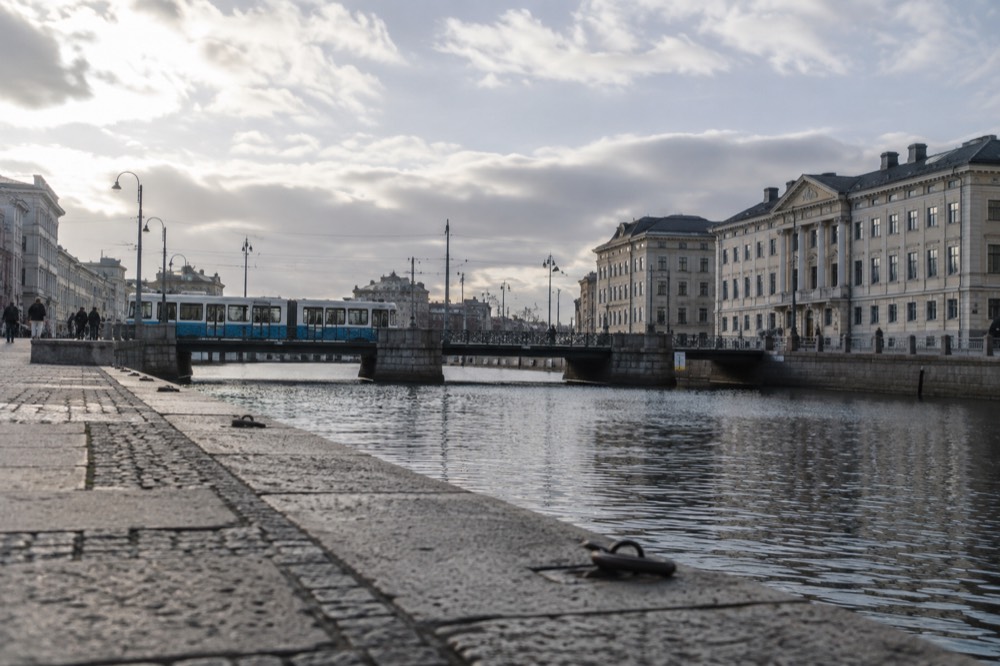
Gothenburg and Göteborg are the same city, and the difference is only language. Göteborg is the city's name in Swedish, the name on the road signs, the tram destinations and the municipal letterhead. Gothenburg is the established English exonym, the name used by the BBC, by English-language guidebooks and by most international airlines. The city's own tourism organisation markets itself as both, depending on which audience it is addressing. There is one city, one municipal government and one tram network, wearing two names.
The confusion is real, though, and it costs travellers money every year. Search "Gothenburg" and you will also find Gothenburg, Nebraska, a small American town in the American Midwest that shares the name and nothing else. Book a hotel, a flight or a tour against the wrong one and you have a problem no train can fix. This page untangles the two names, explains why both exist, and tells you which one to use when you arrive in Sweden.
Are Gothenburg and Göteborg the Same City in Sweden?
Yes, completely. Göteborg is the Swedish name and Gothenburg is the English name for one and the same city, Sweden's second largest, at the mouth of the Göta älv river on the west coast. The municipality calls itself Göteborgs Stad, the city's own population reporting put it at 613,274 residents at the end of 2025, and every English-language publication, from airline timetables to this site, calls the same place Gothenburg. Nothing about the city changes depending on which name you use.
The city sits where the Göta älv river meets the Kattegat, the strait between Sweden and Denmark. Dutch engineers laid out the old town inside a moat in the seventeenth century, and that canal ring still defines the centre today: the sightseeing boats that run the Paddan route literally enter the city through the moat. The name Göteborg itself follows a classic Swedish naming pattern, "the fortified town at the Göta", just as Karlskrona is the "crown town" of Karl and Örebro the town at the bridge over the Svartån.
If you are planning a visit, the practical answer is that either name will get you there. Google Maps, booking sites and airline search fields accept both. Once you land, though, the signage is Swedish only: Göteborg Centralstation, Göteborg Landvetter Airport, Götaplatsen. Nobody renames these for English visitors, and that is worth knowing before you try to match a printed itinerary against a departure board. Our overview of what Gothenburg is known for covers the city's identity in more depth.
Why Does One Swedish City Have Two Names?
Sweden's language authorities and the city itself use Göteborg, while English developed its own form, Gothenburg, centuries ago through Dutch and German trading contacts, and the two settled into parallel use. The English name is not a translation and not a mistake: it is an exonym, the same phenomenon that gives us Munich for München, Prague for Praha and Copenhagen for København. Both names point at the same coordinates on the map.
Exonyms usually survive in English when a place had heavy international contact before modern standardised spelling existed, and Gothenburg is a textbook case. The city was founded as a trading port with a large Scottish, Dutch and German merchant community, and those merchants wrote the city's name in their own languages. The Scottish influence is the reason behind another famous nickname entirely, covered separately in why Gothenburg is called Little London. The English form stuck in commercial correspondence and never left.
The pattern holds across the whole city. The art museum is Göteborgs konstmuseum, the city museum Göteborgs stadsmuseum, and the football stadium Gamla Ullevi and Nya Ullevi, none of which get renamed in English. What English does rename is the city itself and nothing else. A useful rule for travellers: if the word contains "Göteborg" as part of a longer proper noun, keep it exactly as printed. Only the standalone city name has an English twin.
| Context | Name you will see | Language | Example |
|---|---|---|---|
| Road signs, tram displays | Göteborg | Swedish | "Göteborg C" on train destination boards |
| English guidebooks, media | Gothenburg | English | "Gothenburg, Sweden's second city" |
| Official municipality | Göteborgs Stad | Swedish | goteborg.se, the city's own site |
| Tourism marketing | Both | Mixed | Göteborg & Co promotes both forms |
| Airport codes | GOT | Neutral | IATA code for Landvetter |
How Do You Pronounce Göteborg in Swedish?
The Swedish pronunciation is roughly "YUR-tuh-bor-y": the initial G before an ö sounds like an English y, the ö is a rounded vowel with no English equivalent, and the final g softens into a y sound at the end of the word. Stress falls on the first syllable. English speakers saying "GOTH-en-berg" are perfectly understood in Sweden, but the Swedish form sounds quite different from how it looks on paper.
The two trap sounds are the initial "g" and the final "g". In Swedish, g before the vowels e, i, y, ä and ö is soft, pronounced like the y in "yes". So Göteborg starts with a y-sound, not a hard g. The final g in burg-like Swedish place names is also soft, which is why locals say something closer to "bor-y" than "borg". Put together, the word that looks like a heavy Germanic mouthful is actually light and quick.
You do not need it, though. Sweden consistently ranks among the most proficient English-speaking countries in Europe, and Gothenburg is a university city with a huge international trade and tech sector. Hotel staff, ticket inspectors and museum guides all switch to English without hesitation, and the question of what language is spoken in Gothenburg has a simple answer: Swedish officially, fluent English almost everywhere a visitor goes. Attempting "Yur-teh-bor-y" earns goodwill; failing to attempt it costs nothing.
Where Does the English Name Gothenburg Come From?
Gothenburg entered English through the city's seventeenth-century trading community, where Scottish, English, Dutch and German merchants wrote the port's name in their own spellings, and the English form became standard in commercial and diplomatic use. It is not a modern tourism invention: English-language sources have used Gothenburg for the city for centuries, and the name is now fixed in international English, including on this site's own headings.
The city's whole reason for existing was trade, and trade was multilingual from day one. The Scottish merchants who settled there in numbers gave the city its Little London reputation, and their correspondence, along with the Dutch and German business documents flowing through the port, fixed a family of similar spellings across northern Europe. English kept "Gothenburg", German uses "Göteborg" unchanged, and a few other languages have their own variants entirely.
The practical consequence for a traveller is that the English name is not lazy or wrong. When Göteborgs Stad, the municipality itself, communicates in English, it uses Gothenburg in its English text. The city's official destination company is Göteborg & Co in Swedish contexts. Both are correct in their own language, and a bilingual city is comfortable with both. What is not correct is mixing the two inside a proper noun: there is no such institution as the "Gothenburgs konstmuseum", and Göteborg Centralstation is never "Gothenburg Central Station" on the signs, even though English speakers say it that way out loud.
Is There Another Gothenburg Outside Sweden?
Yes, and this is where search engines mislead people. Gothenburg, Nebraska is a real town in the United States, named by settlers in the nineteenth century, and it shares nothing with the Swedish city except the spelling. It has a population of a few thousand, sits on the Platte River in the American Great Plains, and its main claims to fame are a Pony Express station and an annual Swedish heritage festival.
The Nebraska town is the reason every careful article about the Swedish city, including this one, adds "Sweden" somewhere near the top. Search data for "Gothenburg" is polluted by American queries: people looking for Gothenburg, Nebraska hotels, Gothenburg High School sports results or the town's local news. An unwary traveller searching "Gothenburg airport" may be surprised to learn the Nebraska town has no commercial airport at all, while the Swedish city's Landvetter handled 5,435,850 passengers in 2025, according to Swedavia, the airport operator.
The naming direction went from Sweden to Nebraska, not the other way. Swedish and German settlers on the American plains named their town after the port city many of them had sailed from, the same process that scattered Stockholms, Oslos and Copenhagens across the American Midwest. So the Swedish city is the original, the Nebraska town is the homage, and if you are booking anything, the country name is the cheapest insurance you will ever buy. If your itinerary involves Sweden at all, our page on whether Gothenburg in Sweden is worth visiting is the right next click.
Which Name Should You Use When You Visit Gothenburg?
Use Gothenburg in English conversation and Göteborg when reading or matching Swedish signage, tickets and station names, and expect locals to understand both without comment. In practice: say Gothenburg when speaking English, type Göteborg when a booking form or timetable prints it that way, and never rename a Swedish proper noun that contains Göteborg as part of a longer name, such as Göteborgs konstmuseum or Göteborg Centralstation.
The one place the distinction has teeth is on tickets and screens. A train ticket printed "Göteborg C" is the same station an English itinerary calls Gothenburg Central. A tram destination reading "Saltholmen" is the ferry terminal for the southern archipelago regardless of what your English guidebook calls the islands. Match what is printed, not what you expect to be printed, and the two-name city stops being confusing within a day of arrival.
Visitors also ask whether the name affects anything practical, like whether ferry and tram tickets work differently for English speakers. They do not. Västtrafik, the regional transport authority, sells the same tickets through the same app and card readers to everyone, and a single 24-hour Zone A ticket covers trams, buses and the archipelago ferries under one fare structure, as Västtrafik's own Zone A ticket page sets out. The question of how to get around Gothenburg has one answer regardless of which name you give the city.
Do Other Swedish Cities Have English Names Too?
Yes, Gothenburg follows a general pattern. English uses its own names for several Scandinavian places: Copenhagen for the Danish København is the classic example, while within Sweden the pattern is weaker, so Stockholm stays Stockholm and Malmö stays Malmö. Gothenburg is the main Swedish city with a genuinely different English exonym, which is precisely why the two-name question comes up for this city and almost no other in the country.
Stockholm, Malmö, Uppsala and Lund all travel into English unchanged. Gothenburg is the outlier because its founding era and merchant mix were different: it was built as an international port with foreign shareholders and foreign residents, at a moment when English commercial spelling was still settling. The city's name was being written abroad before Sweden standardised its own orthography, and both spellings fossilised side by side.
This matters for search behaviour more than for travel behaviour. Someone comparing Liseberg and Tivoli, Gothenburg's amusement park against Copenhagen's, is really comparing Sweden's second city against Denmark's capital, two cities that both carry English exonyms inherited from trade. Someone asking whether Gothenburg or Stockholm is the better trip is comparing a city with two names against a city with one. The asymmetry is a quirk of mercantile history, not of geography or importance.
Does the Name Change Anything About Booking Tours and Tickets?
No. Tours, attractions and transport in the city are sold under both names interchangeably, and operators list the city as Gothenburg in English marketing while running the same departures from the same docks and stops. The amphibious bus, the canal cruises and the archipelago boats all depart from central Gothenburg, and your ticket works whether the confirmation email says Göteborg or Gothenburg. The only real booking hazard is the Nebraska namesake, not the Swedish spelling.
The sightseeing offer illustrates how bilingual the city's tourism layer is. The amphibious bus tour, rated 4.7 from 4,326 reviews on its listing, is marketed in English as a Gothenburg tour and departs from stops signposted in Swedish. The guided archipelago cruise, rated 4.4 from 1,488 reviews, leaves from the harbour beside the opera house. The canal cruise, rated 4.7 from 783 reviews, runs the moat. Three products, two languages, one city.
A quick word on the one attraction where the name genuinely matters for planning: Liseberg, the amusement park, is not sold on any international booking platform at all, and its own site sells entry and ride passes separately, with entry from 95 kr buying zero rides. That is a Swedish-language-first operation with an English toggle, and the lesson generalises. The more local the product, the more likely the Swedish name is the operative one. The same applies to the archipelago ferries from Saltholmen: the boats carry Västtrafik line numbers, the islands are inside the city's own fare zone, and the timetable pages are Swedish-first with an English layer on top.
Common Questions About Gothenburg and Göteborg
Are Gothenburg and Göteborg the same place?
Yes. Göteborg is the Swedish name, Gothenburg is the English name, and both refer to the same city on Sweden's west coast, which Göteborgs Stad's own reporting puts at 613,274 residents. The municipality uses the Swedish name officially and Gothenburg in its English communications.
Is Gothenburg in Sweden or Nebraska?
Both names exist, but they are different places. Gothenburg, Sweden is the country's second city with a major international airport. Gothenburg, Nebraska is a small Great Plains town named by nineteenth-century settlers after the Swedish port. Always check the country when booking.
Why do English speakers say Gothenburg instead of Göteborg?
The English form developed through the city's seventeenth-century trading community of Scottish, Dutch and German merchants, who wrote the port's name in their own spellings. Gothenburg became the standard English exonym, like Munich for München, and has been in continuous use for centuries.
How do locals pronounce Göteborg?
Roughly "YUR-tuh-bor-y". The initial g is soft before ö in Swedish, the ö is a rounded vowel, and the final g softens to a y sound. English speakers saying "GOTH-en-berg" are understood everywhere, since English proficiency in Sweden is very high.
Should I write Göteborg or Gothenburg?
Use Gothenburg when writing English, and keep Göteborg when it is part of a longer proper noun such as Göteborgs konstmuseum, Göteborg Centralstation or Göteborgs Stad. Renaming those institutions into English is a factual error, not a translation.
Do Swedish people mind the English name?
No. The city's own tourism organisation and municipality use Gothenburg in English-language material. Both names are fully accepted, and signage inside Sweden simply uses the Swedish form because that is the country's official language.
One city, two names, and a third namesake on another continent: that is the whole puzzle. Say Gothenburg at home, read Göteborg on the signs, and add "Sweden" to every search box. For the broader picture of what the city offers, Gothenburg Travel Guide covers the neighbourhoods, the archipelago and the seasons in full, and our answer on what not to miss in Gothenburg is a good place to start building an itinerary.