Do I Need to Buy Train Tickets in Advance in Sweden? The Rules from Gothenburg
Whether you need to book Swedish train tickets in advance, which trains from Gothenburg require a seat reservation, and which local tickets you can simply tap and ride.

Do I Need to Buy Train Tickets in Advance in Sweden?
Sweden's long-distance trains run on a reservation model closer to an airline than a metro: on the main intercity routes you buy a ticket tied to a specific departure, and the price you pay depends heavily on when you buy it. Yet the same country also runs one of Europe's simplest regional systems, where a ticket bought on your phone two minutes before boarding costs the same as one bought two weeks earlier. The answer to whether you need to book ahead is therefore "it depends which train", and the dividing line is easy to state. This site, Gothenburg Travel Guide, covers the question from Sweden's second city, where the country's second-busiest station sits at the centre of the network.
Do I Need to Buy Train Tickets in Advance in Sweden?
For long-distance trains such as Gothenburg to Stockholm, Oslo or Copenhagen, yes: book ahead, because the ticket includes a mandatory seat reservation and prices rise as the departure fills. For regional trains and all local transport in Gothenburg, no: Västtrafik tickets cost the same whenever you buy them, and several regional services are hop-on with any valid ticket. Booking two to four weeks out is the practical sweet spot for intercity travel.
The reason is structural. Swedish long-distance rail was opened to competition, and operators such as SJ and MTRX sell reserved seating on fixed departures, which means the cheapest fare buckets sell out first and last-minute buyers face the highest prices. A traveller who turns up at Göteborg Centralstation on a Friday afternoon expecting a cheap fare to Stockholm is doing the equivalent of walking up to an airline counter on a holiday weekend.
Regional trains work the other way. Around Gothenburg, and on shorter hops such as Gothenburg to Alingsås, the ticket is a zone-based Västtrafik product with a fixed price whether you buy it in the app, at a machine, or the moment before departure. There is nothing to book in advance because there is nothing to reserve. If you want the scenic version of this distinction for the capital route, read is the Gothenburg to Stockholm train scenic.
The split also shapes how you should plan a whole week. If your itinerary is Gothenburg plus one long-distance return to Stockholm, that is a single reservation decision made once, early, online. If your itinerary is Gothenburg plus day trips to Alingsås, Kungsbacka or the archipelago islands, you may never touch a reservation system at all, and a single Västtrafik day ticket covers everything. Many visitors mix both tiers without realising they are doing it, and the ones who book the reserved leg late are the ones who pay for it.
Which Trains from Gothenburg Require a Seat Reservation?
The reserved long-distance trains from Gothenburg are the express services to Stockholm, the cross-border services to Oslo, and the trains south towards Malmö and Copenhagen, plus the private operator MTRX on the Stockholm run. All of these tie your ticket to one departure and one seat. Regional trains to Alingsås, Kungsbacka and within Västra Götaland do not, and neither do Gothenburg's trams or archipelago ferries.
Göteborg Centralstation is the hub for all of this. The practical rule of thumb: if the train leaves the region, it has a reservation; if it stays inside it, it does not. That split has one big consequence for planning. On reserved trains, a missed connection is a problem, because your ticket is only valid on the departure printed on it. On regional trains, a missed train is a shrug, because the next one accepts the same ticket.
Cross-border trains deserve an extra word of caution. The Oslo route and the Copenhagen route via Malmö cross national rail systems, and operators on those corridors can be stricter about both reservations and ticket checks than domestic Swedish staff. Booking those in advance is less about saving money and more about knowing your seat exists on a service that runs a handful of times a day. For the Copenhagen angle specifically, see is Gothenburg worth visiting from Copenhagen.
There is a second, quieter reason to book the long legs early: the departure pattern. Express services between Sweden's big cities are not hourly metros. On some corridors the gap between departures can be an hour or two, and on cross-border routes longer still. A missed reserved train therefore does not just cost money, it can cost half a day of your itinerary. Travellers connecting through Gothenburg, for example arriving off a Copenhagen service and heading north, should build buffer time into the reserved legs precisely because the regional legs need none.
Can You Just Turn Up and Buy a Regional Ticket in Gothenburg?
Yes. Västtrafik regional and city tickets have one flat price whenever you buy them: a single adult ticket for one zone is 38 kr, and a 24-hour Zone A ticket is 125 kr, the same in the app as in a shop. There is no advance-purchase discount and no reservation on any regional train, tram or ferry in the network, so buying early buys you nothing except a quieter morning.
That 24-hour Zone A ticket is more powerful than its price suggests, because Zone A includes not just Gothenburg but also Mölndal, Partille, Öckerö and the southern archipelago islands. Västtrafik's own zone map shows the archipelago ferries from Saltholmen as ordinary lines in the network, which means the same 125 kr ticket covers the tram to the coast and the boat out to sea. That is the cheapest big day out in the city, and no part of it needs advance booking. The zone structure and what it covers is published on Västtrafik's own ticket pages, which are the authority on both fares and validity.
One discount needs careful handling, because it is widely misreported. A temporary state subsidy currently halves the price of every ordinary 30-day period ticket: a Zone A adult monthly has dropped from 890 kr to 445 kr, valid for travel through the end of the year. But the 24-hour and 72-hour tickets a visitor actually buys are not discounted. Transport in Gothenburg is not half price; monthly tickets are. A visitor on a two-day stay should ignore the headline entirely.
There is also one airport trap worth flagging here, because it is a train question people ask. There is no rail link to Landvetter Airport. Swedavia's own transport pages list only coach and bus options, and the airport coach is now branded Vy flygbussarna, running Landvetter to Korsvägen to Göteborg C in a stated 20 minutes. Anyone who read an old guide promising a future airport train should update their plans. The full comparison of airport options is in the site's airport transfer guide, and the short answer for this question is that the airport leg is a bus ticket, bought like any bus ticket, with no reservation tier at all.
For visitors whose days are built around attractions rather than rail corridors, it is worth knowing that the old municipal city card no longer exists and the current pass product is a different thing under different terms. The site's piece on is Gothenburg cheap or expensive puts the transport numbers in the context of a whole trip budget.
Is There a High-Speed Train from Gothenburg to Stockholm?
Yes, several daily departures run the Gothenburg to Stockholm corridor at speeds and timings that make it a genuine competitor to flying, and every one of them is a reserved train where advance booking pays. The corridor is served by both the state operator and private competitors, which is exactly why prices vary so much by departure and by how early you book.
Competition on the route is the traveller's friend, but only the traveller who books early. Multiple operators means multiple fare structures, and each of them prices by demand. The general pattern across all of them: the cheapest tickets appear when sales open, usually months ahead, and the fare climbs as the train fills. A Friday or Sunday evening departure between Sweden's two largest cities is the most contested seat in the country.
The details of the route, its speed and how the scenery compares to other Swedish train rides are covered in the site's dedicated pieces: is there a high-speed train from Gothenburg to Stockholm and is the train ride from Gothenburg to Stockholm scenic. The short version for booking purposes: treat it like a flight, reserve the seat, and do it as far ahead as your dates allow.
A note on timing the purchase. The fare ladder on reserved Swedish trains does not move in a straight line so much as in steps: a cheap bucket sells out, the price jumps, and it stays at the new level until the next bucket empties. This is why two travellers on the same departure can pay very different amounts for the same seat quality. It is also why a flexible traveller can win by shifting a booking a few hours either side of a peak departure: the 07:00 and the 16:00 on the same corridor can sit in different buckets even when the 12:00 is sold out of cheap fares.
How Does the Västlänken Tunnel Change Rail Travel in Gothenburg?
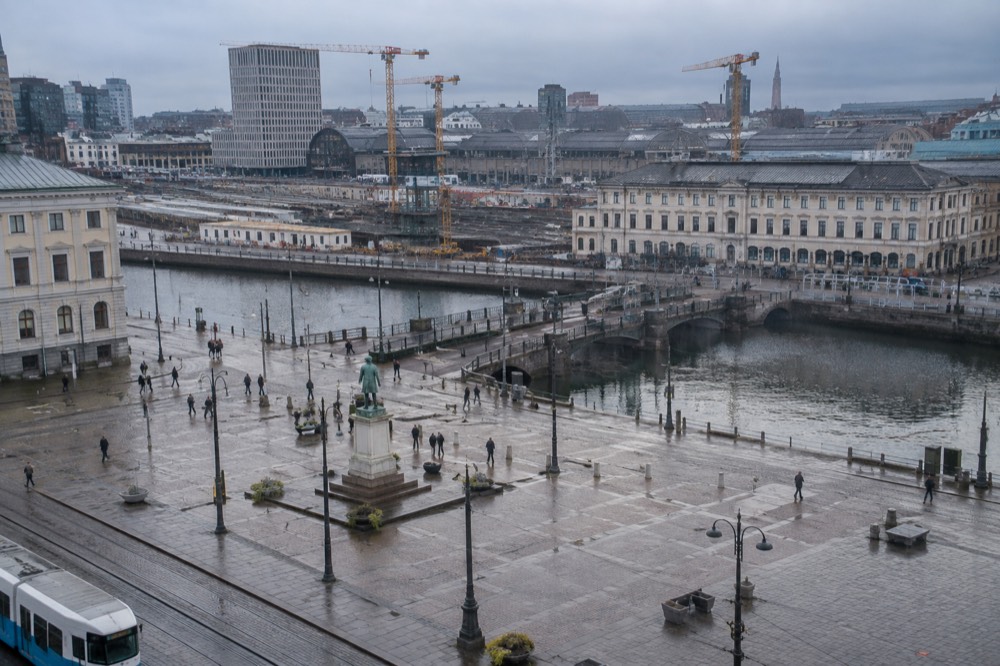
Gothenburg is currently building the Västlänken rail tunnel, and the first section, the underground tracks at Göteborg Centralstation, is scheduled to open in December 2026, with the full project including new central stations at Haga and Korsvägen due around 2030. Until then, central-city construction is ongoing, so allow extra time around the station and expect street diversions.
This matters for the advance-booking question in one specific way. The first trains to use the new underground platforms are regional services such as Gothenburg to Alingsås and Gothenburg to Älvängen, not the long-distance fleet. So the tap-and-ride regional tier is the part of the network getting a capacity upgrade first, while the reserved intercity tier continues to use the existing station environment for now.
For a visitor, the practical effect during construction is mostly about time and orientation. The station district is a building site with a railway running through it, and the walking routes between platforms, bus terminals and the tram stops on the surface change as the works move. Anyone with a tight connection, especially a reserved long-distance departure, should build in more margin than the timetable alone suggests. The project's own information is published by the transport authority at Västtrafik's Västlänken pages, which track the construction phases and opening milestones.
When Should You Actually Book Swedish Trains in Advance?
Book two to eight weeks ahead for long-distance trains in high season, and at least a few days ahead even in low season, because reserved trains keep climbing in price until departure. Do not bother booking regional trains, trams or ferries at all: their prices are fixed and seats cannot be reserved, so a ticket bought at the platform gate is identical to one bought a month earlier.
The one planning habit that beats every fare-hunting trick: know which tier your journey is in before you search. A visitor who checks a booking site for a Gothenburg to Stockholm seat is doing the right thing three weeks out. A visitor doing the same for a tram to Saltholmen is wasting time.
| Journey type | Reservation? | Book in advance? | Why |
|---|---|---|---|
| Gothenburg to Stockholm (express) | Yes, mandatory | Yes, 2-8 weeks | Price rises as fare buckets sell; Friday and Sunday are busiest |
| Gothenburg to Oslo | Yes | Yes, and early | Few departures per day, cross-border service |
| Gothenburg to Malmö / Copenhagen | Yes | Yes | Reserved intercity, demand-priced |
| Regional train within Västra Götaland | No | No | Flat Västtrafik fare, hop-on |
| Gothenburg trams and buses | No | No | 38 kr single, 125 kr for 24 hours, Zone A |
| Archipelago ferries from Saltholmen | No | No | Ordinary Västtrafik lines, covered by Zone A tickets |
Season changes the calculus more in Sweden than in most countries, and not only because of demand. Midsummer is the moment to watch: Swedish cities empty out as everyone heads to the countryside, and reserved trains around the Midsummer weekend fill in a pattern unlike any other weekend of the year. The other seasonal factor is daylight. On 21 June Gothenburg gets 18 hours 6 minutes of daylight, against 6 hours 32 minutes on 21 December, and travellers instinctively pack more into a June day than a December one. A December itinerary with a late-afternoon arrival and an evening of sightseeing planned will find the city dark by mid-afternoon, so the reserved train you book should be the early one, not the cheap afternoon one.
If your Gothenburg itinerary is more about the city itself than the long-distance rails, the attraction pass can do more for your budget than any train fare trick.
What Happens If You Miss a Reserved Train in Sweden?
On a reserved long-distance train, a ticket is valid only on the departure printed on it, so a missed train means buying a new ticket at the walk-up fare unless your fare type allows rebooking. On regional trains, trams and ferries there is no such thing as missing a train in the ticketing sense: the same ticket is simply valid on the next one, which is the single biggest practical difference between the two tiers.
This is why the advice to book long-distance legs early comes with a caveat about certainty. The cheapest fare buckets are often the least flexible, and the operators price flexibility into the ticket the same way airlines do. If your plans involve a flight landing at Landvetter, a ferry arrival from Germany or the UK into the city, or a day trip whose return time you cannot predict, the cheapest advance ticket may be a false economy. The traveller who knows their departure time to the minute should book early and cheap; the traveller who does not should book a flexible fare or accept the walk-up price.
The regional tier carries none of this stress. A visitor who oversleeps, lingers too long over a fika, or watches one more viewpoint sunset has lost nothing except the specific train they intended to catch. The next regional train, tram or ferry takes the same ticket. This asymmetry is worth designing an itinerary around: put the flexible, unpredictable parts of your trip on the regional tier, and reserve the fixed, known legs.
For the ferry arrival case specifically, the site's guide to getting to Gothenburg by ferry from the UK and Germany covers how the terminal connects to the station, which is the moment where a reserved onward ticket is most often missed by arriving travellers.
Common Questions About Train Tickets in Sweden
Do I Need to Buy Train Tickets in Advance in Sweden?
Only for long-distance trains. Reserved services such as Gothenburg to Stockholm, Oslo and Copenhagen are cheaper the earlier you book, and the ticket is tied to one departure. Regional trains and all Västtrafik transport in Gothenburg have flat prices with no reservation system, so advance purchase is unnecessary there.
Can You Buy Swedish Train Tickets on the Day?
Yes, on every train in the country, but on reserved long-distance services you will pay the walk-up fare, which is the most expensive tier. On Västtrafik regional trains and Gothenburg's trams, a day-of purchase costs exactly the same as any other purchase, so there is no penalty at all.
Do Swedish Regional Trains Sell Out?
Regional trains within the Västtrafik system do not use reservations, so they cannot technically sell out, though a crowded rush-hour train may leave you standing. Long-distance trains can and do sell out on peak days, especially around major holidays and summer weekends.
Is It Cheaper to Book SJ Tickets in Advance?
The operators' pricing model is demand-based, so the cheapest tickets are released when sales open and the price climbs as seats fill. Booking as early as your dates are firm is the reliable way to pay less on the Stockholm corridor and cross-border routes.
Do I Need to Book the Airport Train from Landvetter?
There is no airport train. Landvetter Airport has no rail link, and the coach connection is Vy flygbussarna, running to Korsvägen and Göteborg C with a stated journey time of 20 minutes. Book or buy the coach as you would any airport bus; no seat reservation system applies.
Do Gothenburg Trams and Archipelago Ferries Need Advance Tickets?
No. A single Zone A ticket costs 38 kr and a 24-hour Zone A ticket 125 kr, and both cover the tram to Saltholmen and the ferries to the car-free southern islands, which sit inside the city's own Zone A. Buy in the Västtrafik app and board.